Malawi, where more than half the population lives below the poverty line, consistently ranks among the countries hardest hit by climate change, placing 8th on the Global Climate Risk Index in 2024. Roughly 92 percent of Malawians depend on rain-fed water sources, for example, which means every drought, every late onset of rains, every flood directly threatens food production, income, and survival.
The Scottish Government’s Climate Just Communities (CJC) Malawi project—designed to support community climate resilience—closed in March 2026. As CJC’s evaluator, I was asked to assess not only what CJC achieved, but whether its locally led model could be pushed further by embedding sustainability and scale into its approach from the outset. My findings suggest that it can.
What CJC Malawi Achieved
To strengthen the climate resilience of its targeted districts, CJC took a participatory approach and worked through existing community structures such as village disaster risk management committees. Partner communities identified their own climate risks and root causes, highlighted gaps in current responses, and defined high-priority interventions—all of which informed how we implemented the project.
The endline evaluation revealed some impressive results:
- Organic fertiliser use among CJC households jumped from 29 percent to 74 percent.
- Farmers more than doubled their maize production.
- Households with new access to irrigation now harvest three times annually, instead of two.
- Village savings and loans association (VSLA) membership grew significantly, with women in particular reporting dramatic increases in income and economic independence.
- Our partnership with VITALITE (a solar products provider) achieved high solar adoption.
- And household survey data shows CJC beneficiaries are better able to withstand floods and dry spells, supporting greater stability in food production and food security.
But locally led approaches can aim higher still—delivering results beyond the project cycle by building the systemic conditions for scalable, long-term success.
How Do We Scale?
Almost every government has reduced its international development funding, even as countries such as Malawi are experiencing the worsening effects of climate change. The question is how do we do more with the funds available? How do we move from reaching people with one-off activities to truly changing outcomes at scale?
For those of us who work across market systems and private sector development, the answer points to a familiar principle, albeit one that is rarely applied to climate adaptation programming: sustainability comes from working with the actors and incentives already present in local economies.
Economic Actors are Crucial
CJC aligned closely with the Locally Led Adaptation principles. It devolved decision-making to community structures, invested in local capabilities, and built on existing institutions rather than creating parallel ones. This is sound practice. But too often, “locally led” is interpreted narrowly to mean consulting the communities involved, understanding their needs, and designing interventions accordingly.
If we’re serious about achieving scale and sustainability, true local ownership means consulting communities not only about what they want and need, but also about who in the local ecosystem can be part of delivering solutions sustainably. Who has the incentive to stay and to keep reaching the people most affected by climate change even in the absence of external funds?
The answer lies with local economic actors who operate in the private-public space: agro-dealers, seed distributors, local entrepreneurs, microfinance institutions, solar energy companies, and their networks of representatives and retailers. These entities are already embedded in Malawian communities. They are there when international agencies and their projects are not. And, critically, they have an incentive to stay engaged.
What Does Malawi’s Private Sector Look Like?
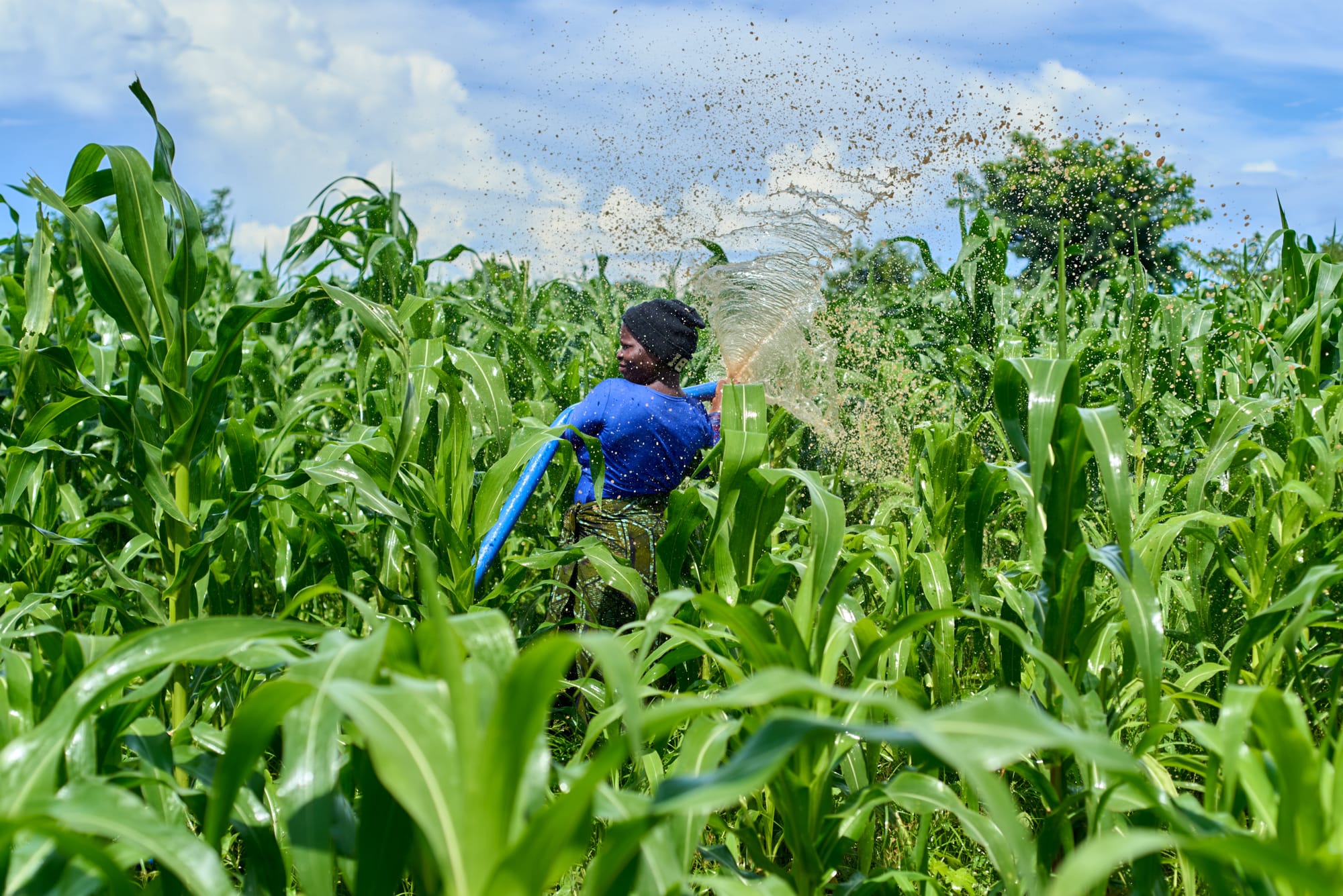
In the development sector, two related misconceptions—that extreme poverty means people can’t afford to buy things, and that the private sector has little interest or role to play in climate action—combine to imply that market-based approaches have limited relevance in the field of climate action. However, CJC’s experience suggests that while Malawi is indeed a low-income country, farmers and communities are still willing to invest in solutions that work for them.
The private sector in Malawi extends beyond big multinational firms. It is the entire chain of lead firms, processors, local dealers and distributors, retailers, and their field representatives. Each business wants to grow and offer solutions that make sense for the people they serve.
I met agro-dealers extending credit to farmers. I spoke with solar companies developing smaller, more portable irrigation solutions specifically for smallholders and farmer groups. Microfinance institutions such as VisionFund Malawi have built climate-related crop insurance and micro-health insurance into their lending products. These enterprises are not donor dependent; they are businesses finding ways to reach underserved customers with the right terms and the right products.
Climate Solutions Are Not Always "Climate" Solutions
Market systems development practitioners have long argued that the tools which enable people to cope with climate shocks are the same tools they use in their daily lives, such as access to weather information, access to finance, and access to agricultural inputs and opportunities to diversify income. These are the same tools we already invest in through private sector development (PSD) and agricultural initiatives.
The implication is significant: scaling climate adaptation in vulnerable contexts does not require us to design an entirely new toolkit. It requires bringing a climate lens to the PSD and agriculture work we already do and making sure it reaches the households and geographies most exposed to climate risk. We have the approaches; the challenge is applying them with deliberate climate ambition.
When floods or droughts destroy crops, farmers do not just lose food. They lose income. They lose security. They lose the ability to prepare for the next shock. Our evaluation found that when you provide a farming household with an alternative income stream such as goat rearing, farmers are noticeably more resilient and, frankly, happier. Having more income security cushions the blow of climate variability because families can afford to prepare, buy inputs for the next season, and keep children in school.
We found that what communities wanted most was greater access to capital so they could invest, prepare, and build resilience on their own terms. With that in mind, setting up and strengthening savings groups was certainly valuable, but not sufficient. The amounts saved by these groups are often too small to fund anything truly transformative. Communities need access to more finance.
Toward a Hybrid Approach
I am not suggesting donors abandon community-based delivery. Existing community structures provide legitimacy, ownership, and reach. Instead, we need to leverage both communal structures and private sector actors to build resilience in climate-vulnerable communities.
In practice, this means designing projects where a portion of the budget goes toward facilitating private sector engagement alongside community-based work. It means mapping the local market ecosystem early in the project cycle and asking: which of our climate objectives could eventually be met by a local actor with the right incentive? It means investing in those commercial actors and helping them develop products, reach new customers, and build distribution networks so that when the donor funding ends, the service does not.
So instead of expecting savings groups to generate enough capital to fund meaningful resilience, we should link them to microfinance providers, and shift from funding repeated farmer trainings to working with agro‑dealers and processors who have commercial incentives to help farmers sustain good agricultural practices. Community structures anchor trust and governance; the private sector brings products, services and capital.
The CJC project made an important start, and its locally led model provides a credible foundation to build on. But if we are serious about scale and sustainability, donors and implementers need to embed that ambition from the outset, designing climate conscious programming that connects community-led action to the local market actors who can sustain it.