Humanitarian action is entering a period of profound adjustment. Rising need, shrinking resources, and increasingly complex crises are forcing governments, donors, and delivery partners to rethink how assistance is financed and delivered. Against that backdrop, the case for humanitarian reform is familiar: moving power and flexible funding closer to local actors; making responses more accountable to affected people; defending international humanitarian law (IHL); scaling anticipatory action, pre-arranged finance, cash assistance, and data-enabled approaches where they are safe and appropriate; and connecting humanitarian action more deliberately with long-term resilience, climate adaptation, livelihoods, and the systems that help people recover and contribute.
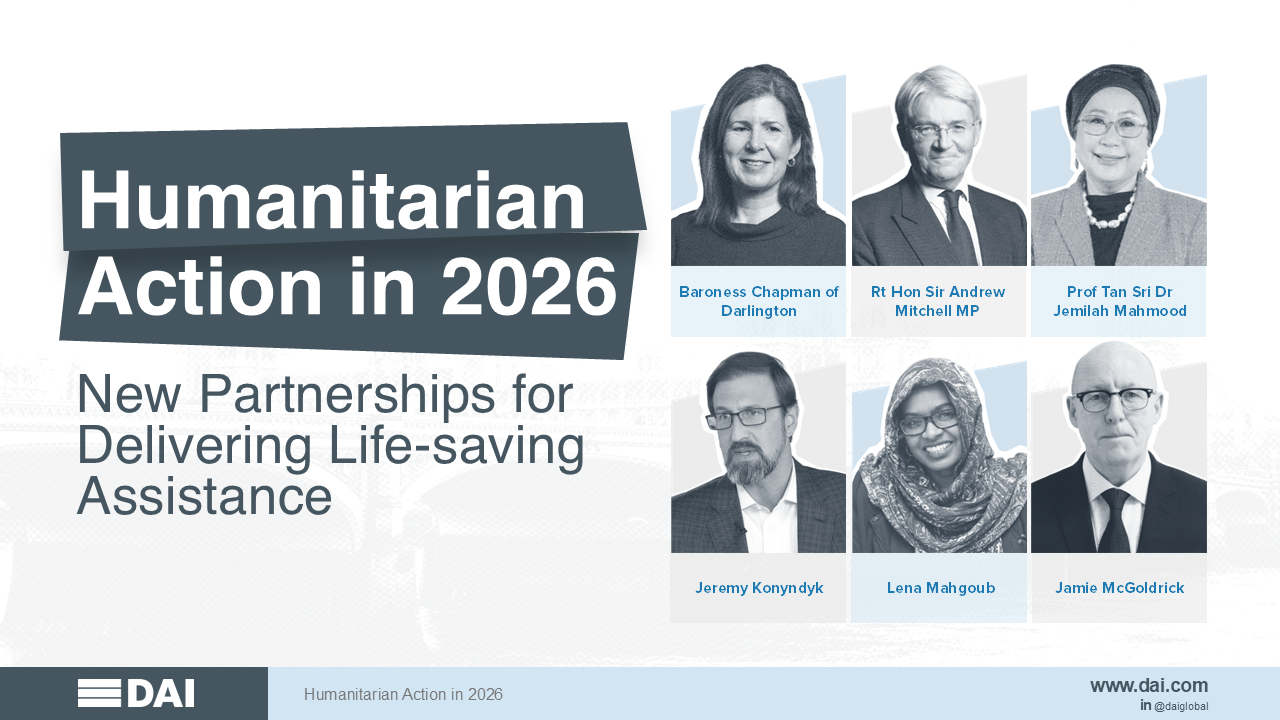
The opportunity now is to build on examples of good practice and embed these approaches more consistently across humanitarian response. In June, DAI brought together voices from government, international groups, civil society, and humanitarian practice to explore how humanitarian action can become more locally led, more accountable, and more effective in a period of acute pressure. This article draws out the propositions from that conversation that are most relevant to a practical agenda for changing incentives, partnerships, and delivery—now.
Three ideas ran through the discussion:
- Local leadership is not an aspiration; it is the starting point of every response, but, as Jamie McGoldrick pointed out, external actors too often fail to act accordingly.
- Accountability and risk need to be shared rather than passed down the chain.
- The United Kingdom can still play a significant role by convening, financing, testing, and scaling better practice, especially where its diplomatic, technical, academic, private sector, and civil society capabilities come together.
The discussion focused on practical propositions, echoing Baroness Chapman’s call for a “new mode of cooperation”: one in which humanitarian action is guided by what communities need and demand; one which is judged not simply by what is delivered, but by whether people receive the support they need to survive, recover, and thrive.
Local Leadership: How, When, and on Whose Terms?
Lena Mahgoub and Dr. Jemilah Mahmood framed the discussion of local leadership by reminding participants that local action is already happening. Local actors are usually the first to respond to crises, remain after international agencies arrive, and continue after they leave. They are not adjuncts to the humanitarian system; in many places, they are the system.
In conflict and fragile settings, the issue is often not an absence of capacity. More commonly, existing capacity has been fragmented by violence, displacement, political disruption, and underinvestment. External partners are therefore most useful when they help connect existing skills, relationships, and knowledge, rather than creating parallel structures or assuming that capacity must be built from scratch.
Although progress on long-promised direct funding remains slow, there is now enough good practice to show what more effective partnership can look like:
- Local women’s and faith-based groups, community networks, and civil society actors help design activities from the outset, rather than being brought in later as implementers.
- Compliance and reporting requirements are proportionate to the scale and nature of the work, without weakening safeguards.
- Value for money is understood in practical terms, including adequate funding for overheads, capacity building, and scale-up.
The Sudan Social Protection Alliance illustrates this direction of travel. Seed-funded by the U.K. Foreign, Commonwealth & Development Office (FCDO) and currently hosted by DAI while it establishes itself as an independent entity, the Alliance is a Sudanese-led platform bringing together experts, practitioners, community networks, and diaspora actors to shape crisis response. It aims to ensure Sudanese experience and leadership inform decisions now, while helping lay the foundations for a future national social protection system.
The challenge, panellists argued, is to make such examples more common. International donors and agencies should ask themselves whether they can:
- scale up and adapt the best partnership models that already exist;
- make meaningful local engagement in design the default, not a special feature;
- ensure funding reaches partners in ways that are timely, predictable, and flexible, whether it is channelled directly or indirectly; and
- treat overheads and institutional capacity funding as investments in quality, accountability, and resilience, rather than as costs to be kept low.
These are not radical propositions. They are commitments that international partners have made repeatedly but still apply unevenly. Britain could show leadership by setting and meeting ambitious, achievable, and measurable expectations for its own partnerships, and by encouraging other donors to do the same.
Accountability, Risk, and the Terms of Partnership
Much of the discussion revolved around accountability and risk. Accountability to affected people and accountability to taxpayers are both essential; they should reinforce rather than compete with each other. Donors are rightly diligent in protecting public funds and maintaining confidence in humanitarian spending, but they have often been less consistent in ensuring that the people receiving support can influence decisions, challenge poor practice, and shape what success looks like.
There is a growing evidence base on accountability to affected populations and on the practical steps funders can take to make it integral to partnerships. Those steps are often straightforward, including setting expectations, encouraging good practice, providing the necessary financing, and rewarding partners that embed accountability throughout project design and delivery.
Risk management is central. Humanitarian responses are inherently risky, so sound risk management is crucial to avoid projects doing harm, scarce resources being wasted, or aid being manipulated by bad actors. The problem arises when risks are pushed onto local partners without the resources, authority, information, or shared analysis needed to manage them.
Too often, donor risk aversion produces additional process rather than better judgement. Genuine partnership requires a different approach: joint analysis of the most material risks, proportionate compliance, clear ownership of decisions, support for partners to strengthen systems over time, and a willingness to make informed, context-specific judgements.
The United Kingdom is well placed to advance this agenda. Its academic institutions, private companies, NGOs, think tanks, and FCDO teams have contributed to some of the strongest thinking and practice on accountability, assurance, and risk management. The opportunity now is to hard-wire that practice into humanitarian work by making compliance more pragmatic, proportionate, and grounded in context.
Protection, International Humanitarian Law, and Responsible Technology
Any serious discussion of humanitarian action must acknowledge the worsening environment for civilians and aid workers. Open and hidden violations of IHL, attacks on humanitarian personnel, restrictions on access, and—as Jeremy Konyndyck remined us—hostile politics around migration all constrain the ability of humanitarians to act. International actors, including states, have a clear role in defending IHL, calling out violations, supporting accountability, and arguing for a more humane and practical approach to refugees and displaced people.
Protection also depends on local knowledge. Local actors often have the best understanding of community dynamics, conflict relationships, access constraints, and sources of risk. They need practical support to keep people safe, including security analysis, negotiation capacity, engagement with local authorities and armed actors, and duty of care for staff and volunteers who are themselves exposed to harm. Building protection into project design from the outset is therefore a core test of partnership quality.
Utilizing artificial intelligence (AI) in humanitarian systems must be considered through the same lens. AI has the potential to improve analysis, forecasting, translation, and operational efficiency, but it can also deepen exclusion, undermine consent, or obscure accountability for decisions. Participants at the event agreed that the question is not whether AI will shape humanitarian response, but who will shape its use, for whose benefit, and with what safeguards.
The recently published SAFE AI Framework is a valuable contribution to that debate because it provides practical governance, assurance, and risk management tools for adopting AI responsibly. The United Kingdom has the technical expertise, regulatory experience, and humanitarian networks to help turn that kind of framework into practical standards for crisis settings, including clearer expectations on data protection, human oversight, bias, explainability, procurement, and redress.
Making Humanitarian Funding Stretch Further
The discussion also raised a wide range of ideas for making scarce resources go further, including areas in which the United Kingdom has been a leader, such as cash assistance, anticipatory action, pre-arranged finance, better and safer use of data, and stronger links between emergency response and longer-term resilience.
The urgency is clear. Tom Fletcher, the UN Under-Secretary-General for Humanitarian Affairs and Emergency Relief Coordinator, has described the sector as facing a “triage of human survival” amid severe funding shortfalls. Against that backdrop, the UN’s Humanitarian Reset seeks to make efficiency, priority-setting, and new forms of partnership central to the future of the system.
Efficiency in this context should be understood as better allocation, not diminished ambition. The aim should be to direct resources to the greatest impact while protecting quality, accountability, and dignity. That means investing in approaches that can reduce need over time, crowding in appropriate private sector, philanthropic, diaspora, and domestic resources, and using humanitarian finance in ways that complement, rather than displace, local systems and long-term development.
There Is Work to Do. Let’s Get on and Do It
Despite aid cuts and political headwinds, participants still saw a strong case for renewed U.K. humanitarian leadership. They pointed to the nation’s role as a major donor, its history of spurring humanitarian reform, and the depth of its technical, financial, climate, development, diplomatic, and humanitarian expertise.
Progress will depend on advancing three mutually reinforcing priorities:
- Act now by identifying, financing, and scaling good practice that is already working.
- Convene internationally, using the diplomatic calendar and reform processes to encourage a race to the top among donors, agencies, and partners.
- Invest in further innovation, including areas where carefully managed risk taking could unlock better models of partnership, financing, protection, and delivery.
In a world that is increasingly divided, and where conflict and climate shocks are combining lethally in more places, it is easy to lose hope. But Sir Andrew Mitchell’s reminder remains important: brave and principled humanitarians continue to serve their communities under immense pressure, and to have extraordinary impact. The task for international partners is to give them the support, resources, authority, and protection they need to do that work well.